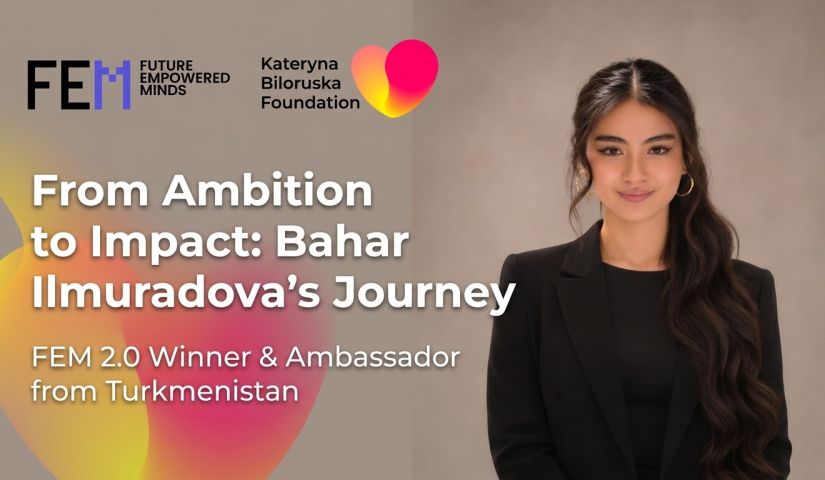
Bahar Ilmuradova started with community initiatives in Turkmenistan and went on to build her own technology project. Along the way she has been guided by curiosity, initiative, and a willingness to challenge herself. Now as a FEM 2.0 winner and FEM Ambassador, she is using what she has learned to make a difference for others.
Creating opportunities
Bahar grew up in Turkmenistan, where international, educational and professional opportunities can be scarce. She learned early to create opportunities instead of waiting for them.
“You learn early not to wait for the ‘perfect’ moment. You create meaning from what you have.”
At the Turkmenabat American Corner, she helped run major initiatives, including the Maker Space and Career Fairs, and EducationUSA events. She also worked as a Maker Space and English Palooza Programs Assistant. These roles built her experience in leadership, teamwork, and community engagement.
Her interest in technology led her to Technovation Girls and TechLab. She was the only female member of her IT Club and kept pursuing her technical interests in a space where girls were rarely seen. Through the Build Your Future Club, she began preparing for the next stage of her education. Today she started her participation in “Empowering Women and Men through Innovation, Technology, and Entrepreneurship” Program alongside her applications to universities, with a focus on majors in technology, artificial intelligence, and innovation.
“These fields were not particularly common interests among girls around me, and I often found myself in technical spaces with very few other female participants. To be honest, I was one of those girls who questioned whether I was capable enough to pursue technology. Even today, I sometimes doubt my abilities, but I’ve learned that confidence doesn’t always come before taking the first step. Sometimes, you have to challenge yourself, embrace being a beginner, and keep learning despite the uncertainty. I hope my journey can encourage other girls to do the same.”
Despite these achievements, Bahar came to see that being busy and accomplishing more did not always mean growing in the ways that mattered most to her.
“I had learned how to perform, how to lead, how to adapt,” she recalls. “But I was constantly growing outward, and I wanted to grow inward with the same depth.”
A new perspective through FEM
Bahar joined FEM 2.0 looking for more than another learning opportunity. She wanted to understand her own decisions better, strengthen her leadership, and connect her ambitions to a clearer purpose.
“It wasn’t just another opportunity. It felt like a natural next step in my journey.”
Through mentorship, interactive sessions, and work with an international community of peers, FEM pushed her to think about leadership differently. Her mentor, Anastasia Lunyk, played a key role in that process. The leadership laboratories made a particularly strong impression. Participants did not just discuss leadership. They worked through practical scenarios that required them to analyze, decide, and reflect on their choices.
“Leadership becomes something you practice, not just something you talk about.”
Sessions on psychology and artificial intelligence were just as valuable, because they tied directly to her interests and to the initiative she was developing. The program culminated in the FEM 2.0 Summit, held online on April 18, 2026.
InnerEcho: from personal vision to growing initiative
A central part of Bahar’s FEM experience was developing InnerEcho. The project combines technology and psychology to promote emotional understanding and make support more accessible. It uses a structured digital process to help people reflect on their experiences and organize difficult thoughts.
With guidance from FEM mentors and experts, Bahar moved the project beyond its first concept. She refined its structure, looked closely at what its users need, and set out practical steps toward implementation.
The project has already drawn encouraging professional feedback. After reviewing the psychological tool Bahar is building for the InnerEcho website, The project has already drawn encouraging professional feedback. After reviewing the psychological tool Bahar is building for the InnerEcho website, Dr. Inna Haas, a psychologist and life and executive coach, a master in emotional intelligence, noted: “I especially value the elements that emphasize validation, emotional safety, and gradual cognitive reframing.”

Balancing this work with university applications and other commitments was demanding, and it taught her an important lesson. “Balancing everything was not about having more time. It was about becoming more intentional with the time I had.”
Bahar has also recently started an internship at Steelrose Legal, where she is gaining practical workplace experience and learning how a professional international team operates, including workplace communication, managing assigned tasks, understanding how projects are organized and executed, and adapting to real-world business expectations. She has already researched approaches to AI search optimization and contributed her ideas for improving the company’s website.
What changed
For Bahar, the most valuable outcome of FEM was not a new set of skills. It was a new way of approaching opportunities and decisions.
“Before, I was very driven and active. Now I don’t just ask ‘what’s next?’ I ask ‘why this, and what impact will it create?’”
She became more reflective, more comfortable with uncertainty, and more aware of the long-term consequences of her choices.
“The program didn’t change my direction. It deepened it.”
Her dedication and progress were recognized when she was named one of the winners of FEM 2.0. She now serves as a FEM Ambassador for Turkmenistan and stays involved in a community that encourages young women to pursue their ambitions and support one another.
As an ambassador, she has already begun giving back. At an alumni meetup with the FEM 3.0 cohort, she spoke openly about her journey, shared lessons from building InnerEcho, and encouraged the new participants to make the most of the program.
Looking ahead
Bahar’s connection with FEM continues beyond the program. She still meets monthly with her mentor, Anastasia Lunyk. In December, she will begin working with a new mentor, Yevheniy Sukhikh, who will help her and her team learn to use AI responsibly and effectively in developing her project.
Her next priority is to develop InnerEcho into a practical, user-centered tool. She plans to:
- consult specialists in psychology and technology
- test the website with real users
- complete its five-stage module, which helps people identify and organize difficult thoughts
She also plans to build a strong team and set clear priorities for the project’s development.
Because InnerEcho deals with emotional well-being, Bahar takes the responsibility seriously. She intends to develop it “carefully and ethically, combining technology with a deep understanding of human psychology.”
Reflecting on her experience, she says:
“FEM has played an important role in both my personal and professional growth. It gave me the space to reflect on who I want to become, take ownership of my journey, and turn my ambitions into meaningful action.”
Bahar’s story shows that leadership does not begin with a title or an award. It begins with curiosity, the courage to take initiative, and a commitment to keep learning. She started by creating opportunities for herself, and she is now building something designed to support others.
The FEM program, run by the Kateryna Biloruska Foundation, supports young women in developing leadership, turning ideas into real initiatives and building a network of like-minded people. Bahar’s story is one example of what that looks like in practice. Since its launch, the program has attracted over 7,000 interested young women and 4,400 applications, uniting 265 graduates across 12 countries, supported by 40+ ambassadors and 30+ mentors. Bahar’s story is one example of what that impact looks like in practice.